

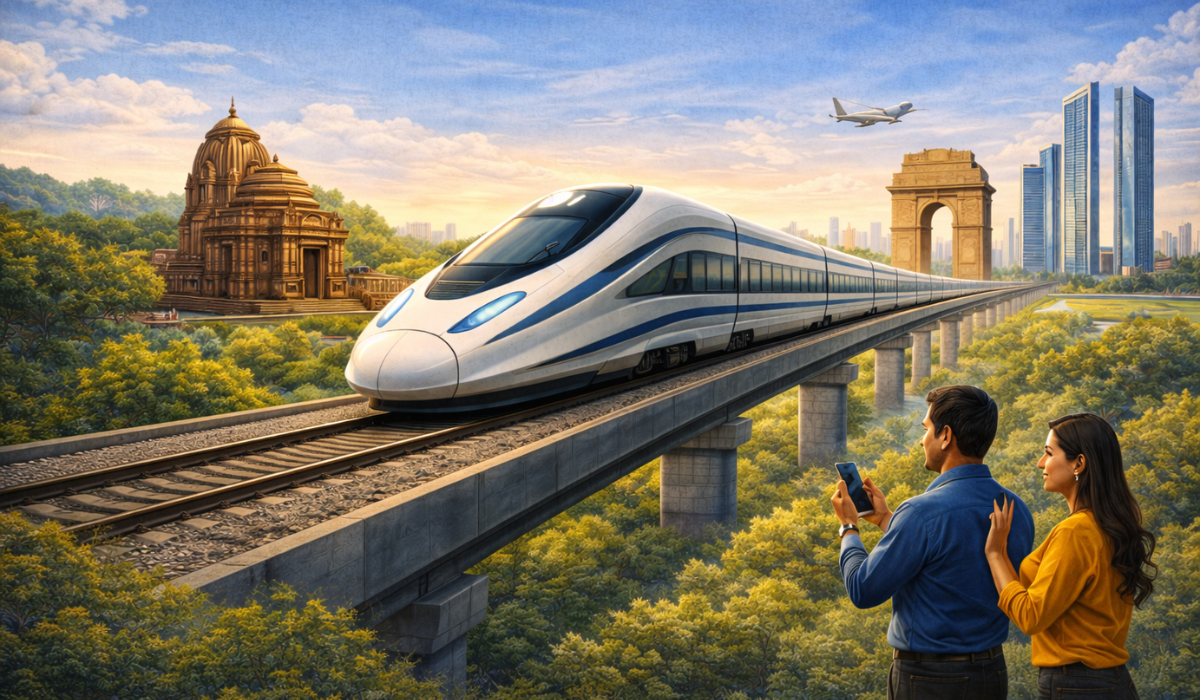
Bullet Train Plans Spark Hope Beyond India’s Announced Corridors
With the Union Budget announcing seven new high-speed rail corridors across India, discussions are gaining momentum in eastern states about future connectivity. Although Odisha is not yet included in the official list, planners and residents are increasingly exploring how the state could eventually join India’s bullet train network.
These discussions reflect Odisha’s growing interest in modern rail infrastructure and faster inter-city travel.
Odisha’s Current Rail Network and Limitations
Electrified Lines but Gaps in Interior Connectivity
At present, Odisha’s railway network spans nearly 3,000 kilometres and is fully electrified. However, many areas, especially interior and southern Odisha, continue to face limited rail access.
As a result, travel times remain long, and economic connectivity between regions is uneven. A high-speed rail corridor could help bridge these gaps and unlock new development opportunities.
How High-Speed Rail Could Transform Travel
Major Reduction in Travel Time
If Odisha were connected to a high-speed rail route—either through a future east coast corridor or as an extension of an existing plan—the impact could be significant.
For instance, travel between Bhubaneswar and New Delhi could be reduced from nearly 30 hours to just 8–9 hours. This would make long-distance journeys faster, more reliable, and more comfortable.
Shorter routes would also benefit. Trips such as Bhubaneswar to Cuttack could take around 15 minutes, while Bhubaneswar to Puri may be completed in about 20 minutes.
Boost to Tourism, Trade, and Regional Growth
Faster Coastal and Inter-State Connectivity
High-speed rail links could also connect Odisha more efficiently with Kolkata and Visakhapatnam. These ultra-fast coastal corridors would support tourism, improve business travel, and strengthen inter-state commerce across eastern India.
Consequently, Odisha could emerge as a vital transit and economic hub along the eastern coast.
Key Challenges in Building High-Speed Rail in Odisha
Infrastructure, Cost, and Planning Requirements
Despite the potential benefits, experts caution that introducing bullet train infrastructure comes with major challenges. High-speed trains require dedicated tracks, straight alignments, and advanced engineering that differ from existing broad-gauge lines.
Moreover, essential steps such as detailed project reports (DPRs), land acquisition, and funding arrangements would need careful planning and coordination.
Learning From Existing Bullet Train Projects
Mumbai–Ahmedabad Corridor as a Model
However, India’s experience with the Mumbai–Ahmedabad high-speed rail project, which uses Japanese Shinkansen technology, is expected to guide future expansions. The technical expertise and financing models developed there could support bullet train expansion into new regions over the next decade.
Odisha’s Long-Term Vision for High-Speed Rail
Connecting the Eastern Coastal Belt
Although Odisha is not part of the first phase of high-speed corridors, the state continues to look ahead. Policymakers believe that high-speed rail connectivity could reduce travel bottlenecks, boost investment, and position Odisha as a key link along India’s eastern coastal belt.
In the long run, such infrastructure could play a major role in shaping the state’s economic and transport future.

Comfortable Travel Across the State Odisha Tourism has introduced a new caravan tourism service. This service allows tourists to explore Read more

NKS Leads Protest on January 28 The Navnirman Krushak Sangathan (NKS), a major farmers’ group in Odisha, has announced a Read more
High Alert Issued Along Odisha-Jharkhand Border In a major anti-Maoist operation, at least 15 Maoists, including the influential leader Patiram Read more
Residents of Bhubaneswar are witnessing a noticeable change in weather as the winter chill gradually fades across Odisha. For the Read more


